






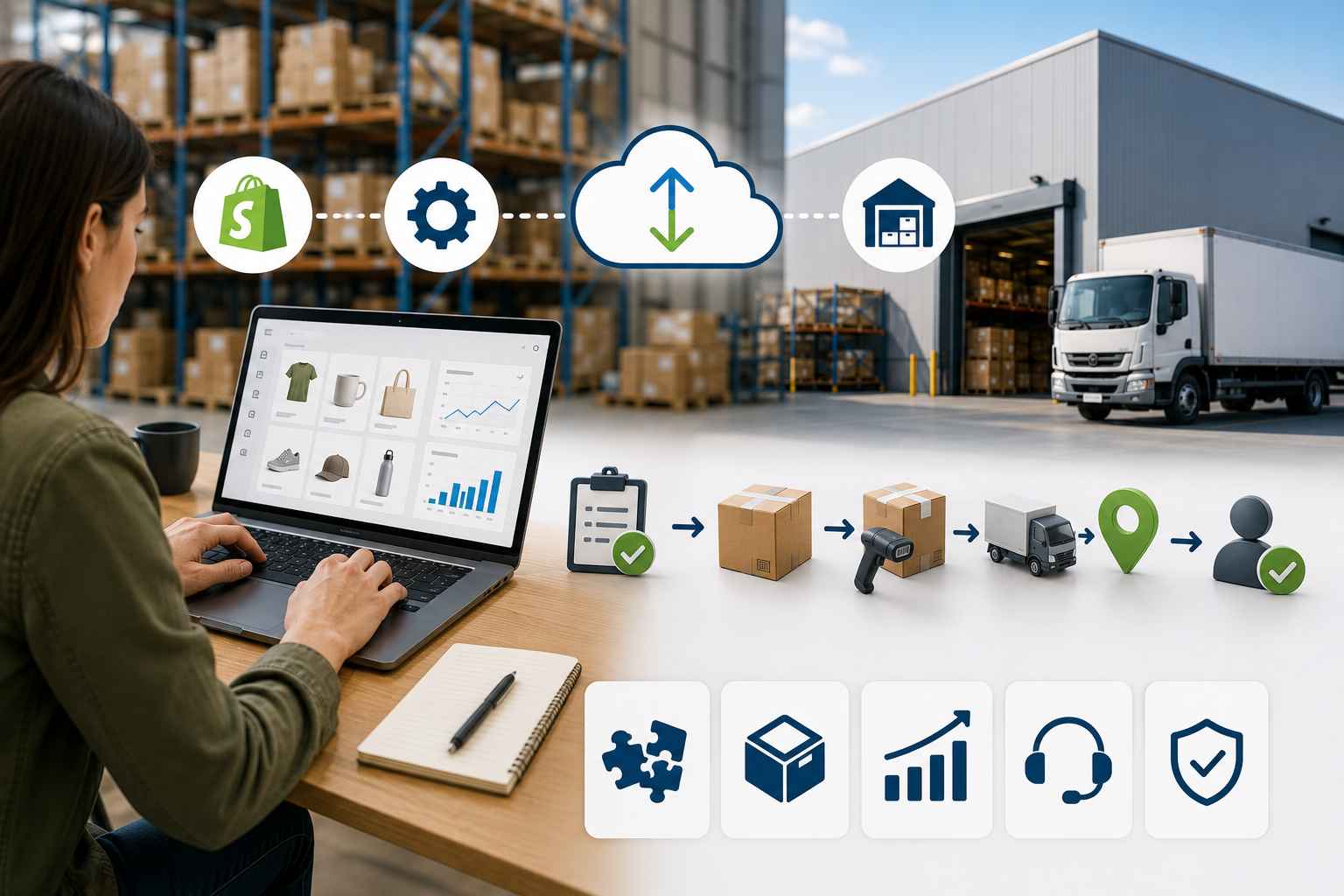
At a certain order volume, fulfilling Shopify orders from your own location stops being a scrappy advantage and starts costing you time you do not have. Packing boxes yourself at 11pm, holding inventory in a spare bedroom, or paying staff to do pick-and-pack in a rented unit all have a ceiling. When you hit it, a third-party logistics provider takes over the physical side of your operation so you can focus on the business.

The mechanics of connecting Shopify to a 3PL are straightforward. What is less obvious is what to look for in a partner before you sign anything, and what can go wrong when the integration is not set up correctly. This article covers both. If you are evaluating whether Cumprimento 3PL is the right move for your store, the section on fit criteria at the end applies regardless of where you are in the process.
How the Shopify-3PL Connection Works
Shopify does not have a built-in fulfillment network for third-party providers the way Amazon does. Instead, the connection between your store and a 3PL happens through one of three routes: a direct API integration the 3PL builds or maintains, a middleware platform that sits between Shopify and the 3PL’s warehouse management system, or EDI for larger operations where that infrastructure already exists.
The most common setup for small to mid-size Shopify merchants is a middleware integration. Platforms like ShipBob, Linnworks, Extensiv, or SKULabs connect your Shopify store to your 3PL’s WMS and handle the order routing, inventory sync, and tracking pushback automatically. When a customer places an order on your store, the middleware picks it up within minutes, routes it to the 3PL as a fulfillment job, and pushes the tracking number back to Shopify once the label generates. The customer sees the tracking update in their order confirmation without any manual steps on your end.
Direct API integrations work the same way functionally but are built and maintained by the 3PL rather than a third-party platform. Some 3PLs have their own Shopify apps in the app store that handle the connection natively. Others will build a custom API connection during onboarding. The advantage of a direct integration is fewer moving parts; the tradeoff is that you are dependent on your 3PL to maintain and update the connection when Shopify changes its API.
The thing that breaks most Shopify-3PL setups is inventory sync. If your Shopify store and your 3PL’s WMS are not in constant two-way communication, you will oversell. A customer buys the last unit of a SKU on your store while the 3PL is still processing a return that would have replenished that stock. Without a live sync, Shopify does not know the unit is gone and keeps selling. Get clear on how frequently your integration syncs inventory counts and whether it handles edge cases like returned units, damaged goods, and pending inbound shipments.
What to Look for in a 3PL Partner
Shopify Experience, Not Just Fulfillment Experience
A 3PL that handles B2B freight or wholesale distribution may not have built the specific workflows that Shopify merchants need. Consumer-facing e-commerce orders are smaller, faster, and more variable than pallet-level wholesale shipments. The pick-and-pack workflow, the returns experience, and the customer-facing tracking communications are all different. Ask specifically whether the provider has active Shopify accounts and what their average order volume per client looks like. A provider whose typical client ships pallets to retailers will struggle with the cadence of a Shopify store shipping 500 individual consumer orders a day.
Integration Depth
Integration depth refers to how much of the order lifecycle your 3PL’s connection to Shopify actually covers. A shallow integration sends the order to the warehouse and pushes a tracking number back. A deep integration also syncs inventory counts in real time, handles order edits and cancellations before the pick ticket generates, routes orders by shipping method or destination zone, and pushes returns back into inventory correctly. Ask for a demo of the integration in a live environment, not a slide deck. Specifically ask what happens when an order gets edited after it is placed, when a return comes back damaged, and when an inbound shipment arrives that affects available inventory. The answers tell you more than the marketing language does. For 3PL warehousing operations connected to Shopify, these edge cases are daily occurrences, not exceptions.
Fulfillment Speed and Cutoff Times
Shopify merchants selling to consumers have been conditioned by Amazon-level delivery expectations. Same-day or next-day order processing is not a premium feature anymore; it is a baseline expectation for buyers. Ask your prospective 3PL what their same-day fulfillment cutoff is, what percentage of orders placed before that cutoff actually ship the same day, and what happens during peak periods when order volume spikes. A provider who hits 98 percent same-day fulfillment in October and 78 percent in December is a provider you will be fielding angry customer emails for during your highest-revenue month.
Returns Handling
Returns are a disproportionate source of Shopify merchant headaches when the 3PL is not set up for them correctly. A customer ships a return back to the warehouse. The 3PL receives it, inspects it, and the unit either goes back to available stock or goes to a secondary disposition channel. The refund trigger needs to fire back to Shopify when the return scans in, not when someone manually processes it at the end of the week. Ask specifically about return processing time, how the refund integration works with Shopify, and whether you get return reason data by SKU.
Pricing Transparency
Fulfillment pricing has a lot of line items: receiving fees, storage fees, pick-and-pack fees, special handling fees, account minimums, and carrier markups. A 3PL that gives you a clean per-order cost in the sales conversation and then invoices you for a dozen additional charges at the end of the first month is a 3PL you will leave within a year. Get a detailed rate card before signing anything and model your actual unit economics against it using your real order data. Include your average order size, SKU count, average units per order, and return rate. The 3PL shipping rates your provider negotiates with carriers are a meaningful part of the total cost, and a provider with real carrier volume should be passing some of that savings to you.
Visibility and Reporting
Once your inventory is at a 3PL, you need real-time visibility into it without having to email your account manager. A client portal that shows live inventory counts by SKU, in-transit shipments, order statuses, and returns in queue is table stakes. If the portal is login-only and updates overnight, that is a problem. If there is no portal and you get a weekly report by email, keep looking.
What the Onboarding Process Looks Like
Most Shopify-to-3PL onboarding runs four to six weeks from signed agreement to live orders. The first week covers account setup: your SKU catalog gets uploaded to the 3PL’s WMS, product dimensions and weights get verified for cartonization and carrier rate calculations, and your storage locations get assigned. Any special handling instructions, like fragile items, items requiring specific packaging, or products with age verification requirements, get documented during this phase.
Integration setup happens in parallel. Your Shopify store connects to the 3PL’s WMS through whichever middleware or direct integration you are using. This is where most onboarding delays happen. API credentials need to be exchanged, webhooks need to be configured, and the order routing rules need to be tested. A test order, or a batch of test orders covering edge cases like multi-SKU orders, out-of-stock scenarios, and address validation failures, should run before any live inventory moves to the facility.
Inventory transfer is the final step. If you are migrating from self-fulfillment, you ship your existing inventory to the 3PL’s warehouse. They receive it, count it, scan it into the WMS, and make it available for fulfillment. If you are migrating from another 3PL, the transfer involves coordinating timing carefully so you do not have a gap where neither facility has inventory available to ship. Ask your new 3PL whether they have handled migrations from your previous provider before, because those transitions have provider-specific quirks.
Red Flags to Watch for Before You Sign
Long-term contracts with steep exit fees are a sign that a provider knows clients leave and wants to make leaving painful. A 3PL confident in their service should not need to lock you in for two years with a five-figure termination clause. Ask for month-to-month terms or at most a 90-day commitment to start, with renewal options once you have confirmed the operation runs the way they promised.
Account minimums that do not fit your current volume are another flag. If a provider requires you to ship 1,000 orders a month to avoid penalty fees and you are shipping 400, either your growth projections are aggressive or you are paying for capacity you are not using. Minimum charges that eat 15 percent of your fulfillment budget before you have placed a single order are a margin problem.
Watch for vague answers on integration specifics. A 3PL that says “we integrate with Shopify” without being able to describe the specific connection method, sync frequency, and edge case handling has probably not done it enough times to know where it breaks. The integration is the nervous system of the whole operation. For e-commerce fulfillment to run smoothly, your store and the warehouse need to be speaking to each other continuously, not periodically.
Slow responses during the sales process predict slow responses when something goes wrong operationally. If it takes three days to get a rate card and you cannot reach anyone by phone, that experience does not improve after you have signed.
When It Makes Sense to Move to a 3PL
The math on self-fulfillment versus outsourcing shifts at different points for different businesses, but a few signals show up consistently. If you are spending more than ten hours a week on fulfillment-related tasks, including packing, postage, carrier drop-offs, tracking questions, and inventory management, you are past the point where your time is being well spent on logistics. That time has an opportunity cost.
If you are capping your order volume because you physically cannot process more orders in the space and time you have available, a 3PL removes that ceiling. If you are running out of storage space at home or in a small unit, a 3PL gives you scalable warehouse capacity without a long-term lease. If you are selling into multiple regions and paying high shipping costs because all your inventory is in one location, a 3PL with the right footprint can cut your average transit time and shipping cost simultaneously.
The volume threshold where outsourcing starts to make financial sense varies by product type, average order value, and the cost of your own time, but many Shopify merchants find the inflection point somewhere between 100 and 300 orders per month. Below that, the per-unit economics of a 3PL often do not beat what you can do yourself. Above it, the operational leverage of a dedicated 3PL warehousing and fulfillment operation typically wins on both time and cost.
Working with Texas Logistics Services for Shopify Fulfillment
Texas Logistics Services handles Shopify fulfillment for e-commerce brands at a range of volumes, from growing stores making the move away from self-fulfillment to established operations looking for a more reliable partner. Our integration connects directly to your Shopify store, syncs inventory in real time, and pushes tracking back automatically so your customers always know where their order is.
If you are ready to get your store connected or want to talk through what the transition looks like for your specific operation, call us at (346) 766-2151 or visit texaslogisticservices.com to request a quote. We can usually get a rate card back to you within one business day.
