





 By Omri Shafran
CEO, Texas Logistic & Fulfillment Services
LinkedIn profile
Did you know? Three of six inbound inquiries Texas Logistic & Fulfillment Services received in July 2026 included a clear geography or facility-location requirement: one wanted a warehouse in Indiana, one preferred a location near IAH, and one was a Houston-based importer setting up U.S. distribution. In this small sample, location shaped 50% of the initial briefs, which is a reminder that inventory placement decisions start with inbound routes and operating constraints, not only outbound parcel distance.
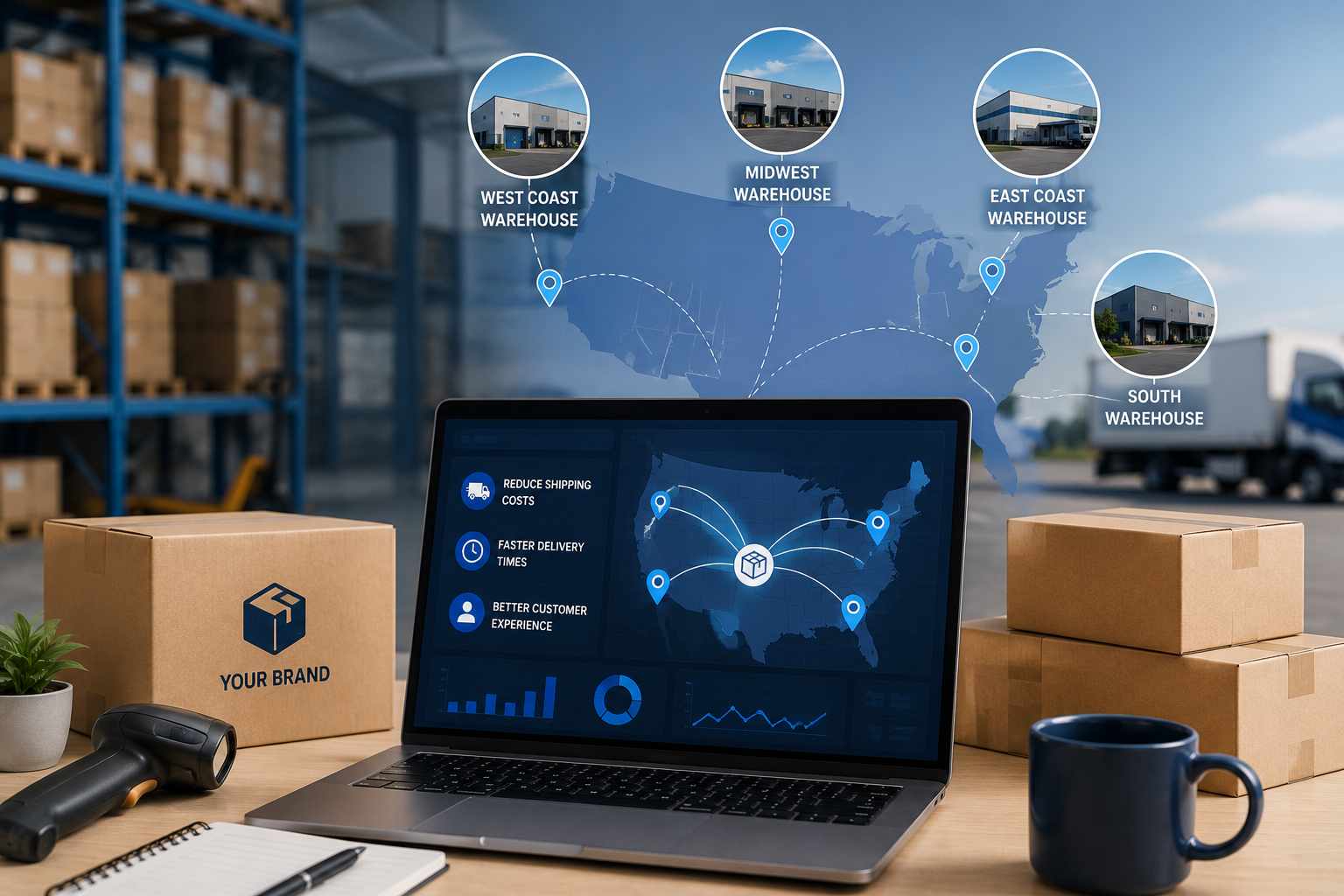
Distributed inventory is a fulfillment strategy where a brand splits its stock across multiple warehouse locations in different geographic regions, rather than shipping everything from a single facility. The primary benefit is reduced shipping zones per order – when inventory is stored closer to end customers, orders travel fewer zones, which directly lowers carrier costs and shortens delivery times. The tradeoff is added complexity in inventory management and replenishment coordination across locations.

Shipping cost is one of the few fulfillment expenses that scales directly with every order you ship, and carrier zone pricing is a major driver of how high that cost runs. Ship a package from a single warehouse in Texas to a customer in New York and you’re crossing six or seven carrier zones. That same package shipped from a fulfillment center in Pennsylvania reaches the same customer in one or two zones – at a cost that can be 30 to 40 percent lower per shipment.
That gap is what distributed inventory is designed to close. The strategy is not new – large retailers and logistics networks have used it for decades – but access to multi-location fulfillment through third-party logistics providers has made it a viable option for mid-market and growing e-commerce brands that can’t justify building or leasing their own regional warehouses.
This article covers how distributed inventory works, what it costs to set up versus what it saves, and how to decide whether your current order geography and volume justify the move. If you’re evaluating 3PL fulfillment options with multi-location capability, this is the framework you need to run that analysis.
How Distributed Inventory Works
The core mechanic is simple. Instead of maintaining a single inventory pool at one location and shipping all orders from there, you split your stock across two or more fulfillment centers in different regions. When an order comes in, your order management system routes it to the fulfillment center nearest to the customer’s delivery address. That center picks, packs, and ships the order – ideally within one or two carrier zones.
The routing logic can be purely geographic (nearest facility wins) or weighted by inventory levels (route to the location with the strongest stock position on the ordered SKU). More sophisticated implementations add cost optimization to the routing decision, factoring in current carrier rates by zone and service level to select the lowest-cost ship point for each order. In practice, geographic proximity and inventory availability cover most of the decision for brands that aren’t running at enterprise scale.
What makes the strategy work is carrier zone pricing structure. Major carriers like UPS, FedEx, and USPS price ground shipments based on zones, which are distance bands measured from the origin zip code. Zone 2 shipments (short distance, typically within the same state or region) cost materially less than Zone 7 or Zone 8 shipments (cross-country). By placing inventory in multiple regions, you convert a large share of your long-zone shipments into short-zone shipments.
Single-Location vs. Multi-Location: A Zone Comparison
A brand shipping exclusively from a single facility in Houston will route most orders to customers in Texas and neighboring states at Zone 2 or Zone 3 rates. Customers in the Northeast, Midwest, and West Coast receive Zone 6, 7, or 8 shipments. If 40 percent of that brand’s orders go to customers east of the Mississippi, 40 percent of its shipping spend carries a significant zone penalty.
Add a second fulfillment location in the mid-Atlantic or Southeast and those Eastern orders shift from Zone 6-7 to Zone 2-3. The shipping cost per order on that segment drops, the transit time drops, and the customer experience improves. The savings compound with volume – at 500 orders a day, shaving $2.50 off the average shipping cost on 40 percent of orders adds up to meaningful annual savings.
How Distributed Inventory Reduces Shipping Costs
Zone reduction is the primary mechanism, but it’s not the only one. Distributed inventory affects your shipping spend in several ways that are worth understanding separately.
Lower Zone Charges
Ground zone rates from major carriers increase at each zone tier. The cost difference between Zone 2 and Zone 7 for a 2-pound package can run $4 to $8 depending on the carrier and current rate card. Multiply that by the share of your orders going to high-zone destinations from your current facility and you have the upper bound of your zone-reduction savings opportunity. Your actual carrier invoices or your shipping platform’s zone distribution report will show you exactly how your current order volume breaks down by zone.
Faster Ground Delivery Reduces Air Upgrade Demand
One indirect cost of shipping from a single centrally located warehouse is customer pressure for expedited shipping. A customer in Boston ordering from a Texas-based brand faces a four or five business day ground transit time. Some percentage of those customers will pay for 2-day air service to get the order faster – which you either absorb or pass through. Move inventory to a location in the Northeast and that same customer gets two-day ground delivery without an air upgrade. The demand for expensive air shipping on your network drops.
Dimensional Weight Optimization
Shipping cost is based on the greater of actual weight or dimensional weight (DIM weight). For many e-commerce products, DIM weight governs the billable weight, meaning the size of the box matters as much as what’s in it. When you operate multiple fulfillment centers, you have the opportunity to stock each location with packaging sized for the products most commonly ordered in that region. That’s a secondary efficiency, but it adds up for brands with wide SKU catalogs. A 3PL warehousing partner managing your inventory across locations can standardize packaging specs per facility rather than using a one-size-fits-all approach from a central location.
Distributed inventory reduces shipping costs primarily by lowering carrier zones on outbound orders. The strategy also reduces demand for expedited air shipping when ground transit times improve for distant customers. The implementation questions – how many locations, which regions, which SKUs to split – depend on your order geography, SKU velocity, and volume. Those factors determine whether the savings justify the added inventory management complexity.
How to Decide If Distributed Inventory Is Right for Your Business
Analyze Your Order Geography First
Before committing to a second or third fulfillment location, map where your orders actually go. Pull 90 days of order data and group it by state or region. If 80 percent of your orders ship to customers within 500 miles of your current warehouse, distributed inventory will produce modest savings – your zone distribution is already relatively short. If your orders spread across the country with significant volume in regions far from your current facility, the zone reduction opportunity is real and worth quantifying.
The analysis you want is a zone distribution report: what percentage of your order volume ships at each zone tier, and what is your average shipping cost per zone. Your current carrier or multi-carrier shipping platform can generate this. Once you have it, you can model what the same order mix would cost if you moved 40 or 50 percent of your volume to a second location in a different region.
Calculate the Break-Even Volume
Running inventory at multiple 3PL locations costs more than a single location in fixed terms. You pay storage fees at each facility, inbound receiving fees when you replenish each location, and some additional overhead in your order management system for multi-location routing. The question is whether the per-order shipping savings exceed those added costs at your current volume. For most brands, the break-even point falls somewhere between 150 and 300 orders per day, though it depends on your average shipping cost, your zone distribution, and the 3PL warehousing fees at each location.
Run the calculation with your actual numbers. Take your current monthly shipping spend on high-zone orders, apply the expected zone reduction from a second location, and compare the savings against the added storage and receiving costs. If the savings exceed the costs at your current volume, the move pays for itself. If they don’t at current volume, identify what order volume would make it work and use that as a planning target.
Decide Which SKUs to Split
Distributing your full catalog across multiple locations ties up more working capital in inventory and increases the complexity of replenishment planning. Most brands are better served by a selective approach: split your highest-velocity SKUs – the 20 percent of your catalog that accounts for 80 percent of your order volume – and keep slower-moving products at a single location.
Slow-moving SKUs at multiple locations accumulate storage fees without generating enough order volume to justify the distribution. Keeping them centralized and absorbing the occasional high-zone shipping cost is the more cost-effective approach until those products hit a volume threshold that changes the math. Your end-to-end order fulfillment provider should be able to help you run that SKU-level analysis against your actual storage and shipping cost data.
When Distributed Inventory Makes the Most Sense
Distributed inventory delivers its strongest returns for brands with a few specific characteristics. High order volume matters – the per-order savings multiply across a large shipment base. Wide geographic order spread matters – if most of your customers are concentrated in one region, a second location in a distant region won’t move enough volume to the short-zone tier to justify the cost. And SKU concentration matters – brands with a tight best-seller catalog are easier to distribute than brands with hundreds of slow-moving SKUs.
The profile that benefits most is a brand doing 200 or more orders per day, with customers spread across at least three or four US regions, and with a top-20 SKU list that covers 70 percent or more of order volume. That combination produces enough zone-reduction savings on enough orders to clear the added fixed costs of a second location with margin left over.
Brands earlier in their scaling curve often benefit more from optimizing their single-location operation first – getting packaging DIM weight under control, negotiating carrier rates based on volume, and using zone-skipping programs offered by some carriers for specific lanes. Those improvements don’t require the inventory management complexity of a distributed model and can produce meaningful shipping cost reductions as a stepping stone.
常见问题
What is distributed inventory in e-commerce?
Distributed inventory in e-commerce is a fulfillment approach where a brand stores stock at multiple warehouse locations spread across different geographic regions. When a customer places an order, the system routes fulfillment to the location closest to the delivery address. The strategy reduces carrier shipping zones on outbound orders, which lowers per-shipment cost and shortens transit time compared to shipping everything from a single central location.
How many warehouse locations do you need for distributed inventory?
Most e-commerce brands see meaningful shipping cost reduction with two strategically placed fulfillment locations. A common starting configuration pairs a South-Central or Southeast location (serving the South, Midwest, and parts of the East) with a West Coast location (serving California and the Pacific region). Three locations add a Northeast or Mid-Atlantic node for brands with heavy East Coast order volume. Going beyond three locations generally requires very high order volume and a sophisticated inventory management system to justify the added complexity.
What is the difference between distributed inventory and dropshipping?
Distributed inventory means a brand owns or controls its inventory and stores it at multiple third-party or owned fulfillment centers. The brand ships orders from its own stock, just from geographically dispersed locations. Dropshipping means the brand never holds inventory at all – orders are routed to a supplier or manufacturer who ships directly to the customer. Distributed inventory gives the brand control over quality, packaging, and ship time. Dropshipping trades that control for lower capital requirements.
