






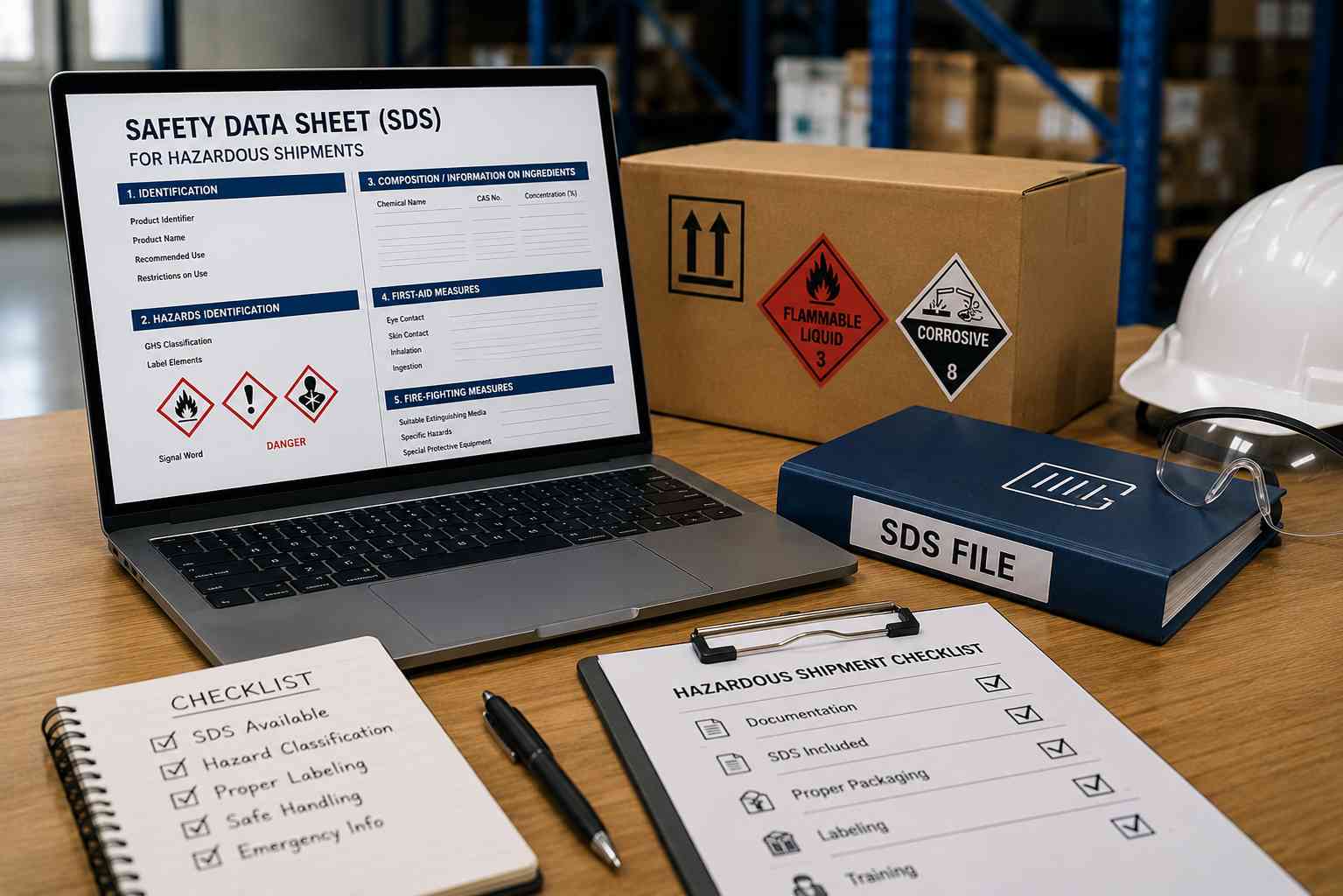
A Safety Data Sheet (SDS) is a standardized 16-section document that describes the physical and chemical properties, health and environmental hazards, safe handling requirements, and emergency response procedures for a hazardous material. Under OSHA’s Hazard Communication Standard (HazCom 2012), SDS documents follow the GHS format. Shippers, carriers, and warehouse operators use them to classify hazardous materials, comply with DOT transportation regulations, and establish safe handling protocols throughout the supply chain.
Every hazardous material moving through the US supply chain carries documentation that describes what it is, what it can do, and what to do when something goes wrong. That documentation is the Safety Data Sheet — and for shippers, carriers, and 3PL operators, it’s not background paperwork. It drives classification decisions, shipping paper preparation, labeling requirements, and emergency response planning.
The shift from the older Material Safety Data Sheet (MSDS) format to the current SDS standard under GHS alignment was completed in 2016. Current SDS documents follow a strict 16-section structure that’s consistent across manufacturers and countries that have adopted GHS. If you’re still receiving MSDS documents from a supplier, those are non-compliant and you should request an updated version.
Understanding how to read an SDS and extract the information relevant to transportation is a core competency for anyone managing hazardous material warehousing or preparing hazmat shipments. This article covers the 16-section structure, the sections that matter most for transport compliance, how SDS data connects to DOT classification, and the most common errors shippers make when working with these documents.
What an SDS Is and Who Requires It
OSHA’s Hazard Communication Standard requires chemical manufacturers and importers to prepare an SDS for every hazardous chemical they produce or import, and to pass it along the supply chain to downstream users. Employers who use hazardous chemicals must maintain SDS documents for every substance in their workplace and keep them accessible to workers during every shift.
For transportation purposes, the SDS provides the technical data needed to determine whether a product is a regulated hazardous material under DOT’s 49 CFR, and if so, how it must be classified, packaged, labeled, marked, and documented for shipment. The SDS alone doesn’t complete a DOT compliance determination — that requires cross-referencing the Hazardous Materials Table in 49 CFR Part 172 — but it’s the starting point for every classification decision.
Carriers are also stakeholders. When a carrier accepts a hazmat shipment, they need to be able to verify the material’s properties against the shipper’s documentation. Many carriers and freight forwarders require SDS submission before accepting certain hazmat shipments, separate from the shipping papers the shipper is required to provide under 49 CFR.
The 16 SDS Sections: What Each Contains
GHS-aligned SDS documents follow a mandatory numbered structure. The sections are titled identically across all compliant documents. For transportation and warehousing purposes, they fall into three functional groups.
Hazard and Composition Sections (1–3)
Section 1 identifies the product by name, synonyms, and manufacturer contact information. Section 2 is the most important starting point for classification — it lists the GHS hazard categories assigned to the product (flammable liquid, oxidizer, corrosive, acute toxicity, etc.), the signal word, hazard statements, and precautionary statements. Section 3 lists chemical components, CAS numbers, and concentrations for mixtures, which matters when you’re determining whether a mixture crosses a regulatory threshold for hazmat classification.
Safety Response Sections (4–6)
Sections 4 through 6 cover first-aid measures (by exposure route), fire-fighting requirements including suitable extinguishing media and combustion hazards, and accidental release procedures for spills and leaks. These sections primarily support emergency response planning for warehouse operators and carriers. Section 5 informs fire suppression system design for storage facilities handling flammable or reactive materials.
Handling, Storage, and Exposure Sections (7–8)
Section 7 covers storage requirements — temperature ranges, ventilation needs, incompatible materials to segregate, and special handling conditions. For hazardous material warehousing operations, this section drives storage location assignments and facility condition standards. A flammable liquid requiring ventilated, temperature-controlled storage away from oxidizers can’t share a standard ambient bay. Section 8 covers occupational exposure limits and required personal protective equipment for workers handling the material.
Physical Properties and Reactivity Sections (9–10)
Section 9 is critical for transportation classification. It contains the flash point, boiling point, vapor pressure, physical state, and other properties that determine hazard class and packing group. Flash point is particularly consequential — it determines whether a liquid is classified as a flammable liquid (below 60°C / 140°F closed cup) under DOT regulations. Section 10 covers reactivity, stability conditions, and incompatible materials, which informs load segregation decisions for mixed hazmat shipments.
Toxicology, Environment, and Disposal Sections (11–13)
Section 11 covers toxicological data including routes of exposure and acute and chronic health effects. This is relevant when evaluating whether a material qualifies for a DOT Poison Inhalation Hazard (PIH) designation. Section 12 covers environmental fate and aquatic toxicity, including whether a material qualifies as a marine pollutant for vessel shipments. Section 13 covers disposal requirements for product and contaminated packaging, which matters for warehouse operators managing damaged or expired hazmat inventory.
Transport, Regulatory, and Administrative Sections (14–16)
Section 14 is the most directly transportation-relevant section. It lists the UN number, proper shipping name, hazard class, packing group, and applicable special provisions under DOT, IATA, IMDG, and ADR. Treat it as a starting point — always verify Section 14 entries against the current Hazardous Materials Table in 49 CFR Part 172 before finalizing shipping papers. Section 15 identifies other applicable regulations including CERCLA reportable quantities and SARA Title III thresholds. Section 16 gives the SDS preparation and revision dates — check this to confirm the document is current.
How SDS Information Connects to DOT Hazmat Classification
SDS documents and DOT’s 49 CFR regulations operate in parallel but aren’t the same system. The GHS hazard classifications in an SDS are an internationally harmonized framework for communicating chemical hazards. DOT’s classification system has its own specific criteria, exceptions, and regulatory history. You can’t read a GHS class from Section 2 and write it directly onto a shipping paper as the DOT hazard class without verification.
The practical workflow starts with Sections 2 and 9 to identify the likely hazard class and confirm the physical properties needed to support it (flash point for flammables, pH for corrosives). Then you cross-reference the Hazardous Materials Table in 49 CFR Part 172.101 to confirm the proper shipping name, hazard class, packing group, and special provisions. Section 14 of the SDS should already contain the UN number and proper shipping name to guide that lookup. For businesses managing regular hazardous material shipping operations, keeping SDS files current is an ongoing compliance obligation — request updated documents from suppliers at least annually and whenever a product is reformulated.
Common SDS Errors in Hazmat Shipping
Working from Outdated Documents
Manufacturers update SDS documents when formulations change, when new hazard data emerges, or when regulations require reclassification. An SDS with a revision date from several years ago may not reflect the current classification. Request updated SDS documents from suppliers annually for regularly shipped materials, and always request a new version when a supplier announces a reformulation.
Misreading Flash Point Test Methods
DOT’s flammable liquid threshold (below 60°C / 140°F) applies to closed cup flash point measurements. Some SDS documents report both closed cup and open cup values — the open cup result is typically higher. Using the open cup figure can cause a regulated flammable liquid to be misclassified as non-hazardous. Always confirm which test method the reported flash point reflects before applying it to a classification decision.
Treating Section 14 as the Final Word
Section 14 entries sometimes contain errors, use non-standard shipping names, or lag behind the current edition of 49 CFR. Treat Section 14 as a reference to verify, not a substitute for looking up the material in the Hazardous Materials Table directly.
SDS Requirements for 3PL Operations
A 3PL storing or handling hazardous materials must maintain SDS documents for every hazardous chemical in the facility under OSHA HazCom, and meet DOT’s pre-transportation function requirements for any hazmat prepared for outbound shipment. When you deliver hazardous inventory to a 3PL, the current SDS for each material should be transmitted in advance or accompany the inbound shipment. A warehouse operator receiving hazmat without an SDS can’t classify the material for storage, can’t brief workers on handling requirements, and can’t respond to an incident correctly. Responsible 3PL operations require SDS submission as a condition of accepting hazmat inventory.
Perguntas mais frequentes
What is the difference between an SDS and an MSDS?
MSDS (Material Safety Data Sheet) was the predecessor format used before OSHA adopted the GHS-aligned SDS standard. The transition was completed in 2016. The key difference is structure: MSDS documents had no consistent section format across manufacturers. GHS SDS documents follow a mandatory 16-section structure that is uniform globally. An MSDS received from a supplier today is non-compliant — request a current SDS.
What section of an SDS has the UN number?
The UN number, proper shipping name, hazard class, and packing group are in Section 14 (Transport Information). Section 14 typically covers DOT, IATA, IMDG, and ADR classifications in separate subsections. Always verify Section 14 data against the current Hazardous Materials Table in 49 CFR Part 172 before preparing shipping papers.
How often should SDS documents be updated?
OSHA requires manufacturers and importers to update SDS documents within three months of becoming aware of significant new hazard information. There is no fixed calendar interval — updates are triggered by new data, formulation changes, or regulatory reclassification. For shippers, best practice is to request updated SDS documents from suppliers annually and whenever a product reformulation is announced.
Can a 3PL refuse hazmat inventory without an SDS?
Yes. A 3PL has both regulatory and operational grounds to refuse hazmat inventory that arrives without a current SDS. OSHA HazCom requires SDS documents to accompany hazardous chemicals entering a workplace. Without one, the 3PL cannot classify the material for storage, establish handling procedures, or respond correctly to an incident. Reputable hazmat-capable 3PLs require SDS submission as a standard intake condition.
Work with a 3PL That Handles Hazmat Compliance
Texas Logistics Services provides hazardous material warehousing and logistics from our facility in Sugar Land, TX. We maintain SDS documentation for every hazardous product in our facility, meet DOT pre-transportation compliance requirements, and require current SDS submission for all inbound hazmat inventory.
Contact us at (346) 766-2151 or visit texaslogisticservices.com to discuss your hazmat storage and shipping needs.
