






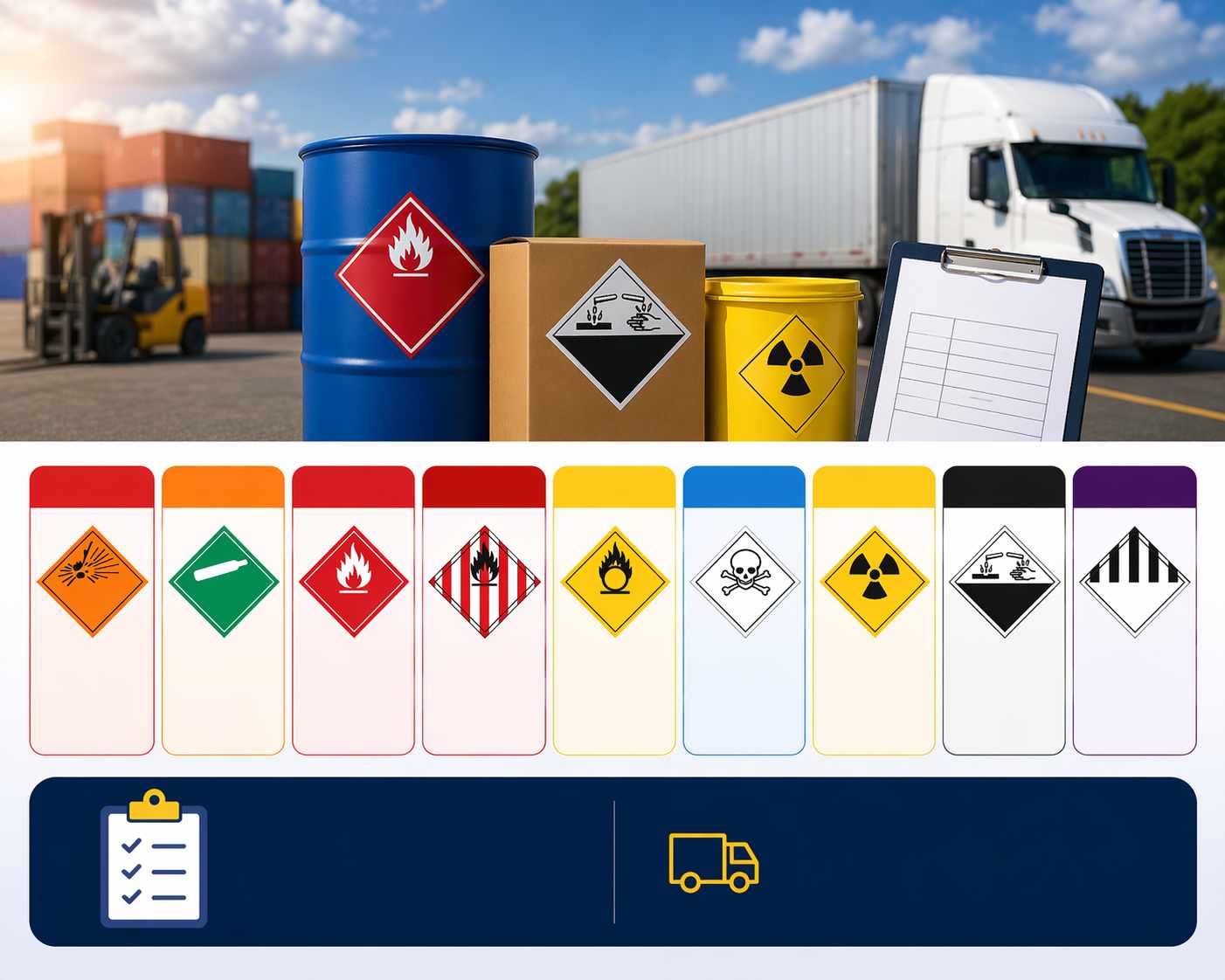
DOT hazmat classification is the federal system that assigns every dangerous good a specific hazard class based on the risk it poses during transport. The U.S. Department of Transportation (DOT) requires shippers, carriers, and 3PL providers to identify the correct hazmat class before a single package moves – by road, rail, air, or sea. Getting the classification right is not optional. Misclassification triggers fines, shipment delays, and in serious cases, criminal liability. Hazmat classification matters because it drives every other compliance decision: which packaging you use, which labels you apply, which shipping papers you prepare, and which carriers will accept your freight. Misclassification triggers fines, shipment delays, and in serious cases criminal liability under DOT’s Hazardous Materials Regulations.
This guide breaks down all nine DOT hazmat classes, explains what each one covers, and clarifies what shippers need to know before handing off hazardous materials to a fulfillment or warehousing partner.

Why Hazardous Materials Classification Matters
The DOT’s Hazardous Materials Regulations (HMR), found in 49 CFR Parts 100-185, exist to protect workers, carriers, and the public from the risks that dangerous goods carry. Classification drives every other compliance decision: the packaging you use, the labels you apply, the shipping papers you prepare, and whether a carrier will accept your freight at all.
For shippers using a third-party logistics provider, classification also determines which facilities can legally store and handle your products. Not every warehouse is equipped or permitted to accept hazardous materials. If you ship products that fall under DOT hazmat classes, you need a partner with the right infrastructure and compliance knowledge.
Texas Logistics Services provides hazardous material warehousing for businesses that need compliant storage and handling in the Greater Houston area, including Sugar Land, TX.
The 9 DOT Hazmat Classes, Explained
The DOT divides hazardous materials into nine primary classes. Some classes are further divided into divisions when the hazard type varies significantly within the class. Here is what each one covers.
Class 1: Explosives
Class 1 covers substances and articles that can detonate, deflagrate, or produce an explosion or pyrotechnic effect. The class is split into six divisions:
- Division 1.1 – Mass explosion hazard (e.g., dynamite, TNT)
- Division 1.2 – Projection hazard without mass explosion
- Division 1.3 – Fire hazard and minor blast or projection hazard
- Division 1.4 – Minor explosion hazard (e.g., ammunition, fireworks)
- Division 1.5 – Very insensitive explosives
- Division 1.6 – Extremely insensitive detonating articles
Most commercial shippers encounter Division 1.4, which includes small arms ammunition and certain consumer fireworks. Consumer-level fireworks classified as Division 1.4G can move through standard freight channels, though carrier acceptance varies.
Class 2: Gases
Class 2 includes compressed, liquefied, dissolved, or refrigerated liquefied gases, plus aerosols. The three divisions reflect the primary hazard:
- Division 2.1 – Flammable gases (e.g., propane, butane, hydrogen)
- Division 2.2 – Non-flammable, non-toxic gases (e.g., nitrogen, carbon dioxide, compressed air)
- Division 2.3 – Toxic gases (e.g., chlorine, ammonia in gas form)
Aerosols containing a flammable gas propellant also fall under Class 2.1. Shippers of consumer products like spray paint, hairspray, or compressed air dusters frequently encounter this classification.
Class 3: Flammable Liquids
Flammable liquids are defined as liquids with a flash point at or below 60°C (140°F). This is one of the most commonly shipped hazmat classes in commercial freight and includes:
- Gasoline and diesel fuel
- Alcohol-based products above certain concentration thresholds
- Acetone and paint thinners
- Certain adhesives and coatings
Flash point determines classification. Liquids with a flash point above 60°C may still carry subsidiary hazards that affect labeling and packaging requirements.
Class 4: Flammable Solids, Spontaneously Combustible, and Dangerous When Wet
Class 4 covers three distinct hazard types, each with its own division:
- Division 4.1 – Flammable solids (e.g., matches, magnesium powder, self-reactive substances)
- Division 4.2 – Spontaneously combustible materials that can ignite without an ignition source (e.g., some metal powders, charcoal)
- Division 4.3 – Dangerous when wet materials that emit flammable gas on contact with water (e.g., sodium, calcium carbide)
Division 4.3 materials require particular care during storage. Contact with moisture or water intrusion can trigger a hazardous reaction, which places strict requirements on warehouse environment controls.
Class 5: Oxidizers and Organic Peroxides
- Division 5.1 – Oxidizers that support combustion and can intensify fires (e.g., ammonium nitrate, hydrogen peroxide above 8%)
- Division 5.2 – Organic peroxides, which are thermally unstable and can self-heat or react violently
Many cleaning products, pool chemicals, and industrial bleaches fall under Division 5.1. Organic peroxides (Division 5.2) require temperature-controlled storage and strict segregation from fuels and combustibles.
Class 6: Toxic and Infectious Substances
- Division 6.1 – Toxic substances that can cause death, injury, or harm to human health through ingestion, inhalation, or skin contact
- Division 6.2 – Infectious substances, including biological agents and medical waste
Division 6.1 includes pesticides, certain industrial chemicals, and some pharmaceuticals. Division 6.2 is relevant to healthcare shippers and diagnostic labs moving patient specimens or Category A infectious substances.
Class 7: Radioactive Materials
Class 7 covers any material with a specific activity greater than 70 kBq/kg. Subclassification depends on the type of radiation emitted and the transport index, which measures dose rate at one meter from the package surface. This class is primarily relevant for nuclear industry shippers, hospitals (radiopharmaceuticals), and industrial equipment manufacturers using radioactive components.
Class 8: Corrosive Substances
Corrosives are materials that cause full-thickness skin destruction or corrode steel or aluminum at a defined rate. Common examples include:
- Sulfuric acid and hydrochloric acid
- Sodium hydroxide (lye) in concentrated form
- Battery acid from lead-acid batteries
- Certain cleaning and drain-clearing products above threshold concentrations
Packaging for Class 8 materials must resist the corrosive action of the substance itself, which limits container choices and can increase per-unit shipping costs.
Class 9: Miscellaneous Hazardous Materials
Class 9 is the catch-all for materials that present a hazard during transport but do not meet the criteria for Classes 1 through 8. It includes:
- Lithium batteries (UN 3090, UN 3091, UN 3480, UN 3481)
- Dry ice (solid carbon dioxide)
- Magnetized materials
- Elevated temperature materials
- Environmentally hazardous substances
Lithium batteries are the most commercially significant Class 9 material. Virtually every shipper of consumer electronics, power tools, or mobility devices encounters lithium battery regulations. IATA and ICAO impose additional restrictions for air transport of lithium batteries beyond what DOT requires for ground.
How Hazmat Classification Connects to Your 3PL and Warehousing Setup
Classification is not just a shipping exercise – it shapes your entire fulfillment chain. A product’s hazmat class determines:
- Whether a warehouse can legally store it
- What ventilation, containment, or fire suppression systems are required
- Which carriers will accept it and under what conditions
- What training must your 3PL’s staff have
- How your inventory must be segregated from non-hazardous goods
For shippers outsourcing fulfillment, this means you cannot simply drop hazmat products into a standard
For shippers outsourcing fulfillment, this means you cannot simply add hazmat products to a standard 3PL warehousing arrangement and expect everything to work. You need a provider whose facility is permitted and configured for your specific class.
The same applies to Cumplimiento 3PL operations – pick, pack, and ship workflows for hazmat products require staff trained under 49 CFR Part 172 Subpart H, plus proper packaging and documentation at the point of order processing.
Shipper Responsibilities Under DOT Hazmat Regulations
The DOT holds shippers primarily responsible for correct classification. Your obligations include:
- Identifying whether your product meets the definition of a hazardous material under 49 CFR 173
- Selecting the correct hazmat class, division, packing group, and UN identification number
- Using DOT-specification packaging appropriate for the material
- Applying the correct hazard labels, markings, and placards
- Preparing accurate shipping papers (hazmat description, emergency response information)
- Registering with the Pipeline and Hazardous Materials Safety Administration (PHMSA) if your shipment volumes require it
The “I didn’t know it was hazmat” defense does not hold in enforcement actions. If your product meets the regulatory definition of a hazardous material, you are responsible for classifying and documenting it correctly – regardless of whether your logistics provider catches the gap.
When you work with a provider offering hazardous material warehousing, part of the value is having a team that understands these requirements and can flag classification and documentation issues before they become compliance problems.
Common Hazmat Classification Mistakes Shippers Make
Several misclassification patterns come up repeatedly across industries:
Overlooking limited quantity and excepted quantity exemptions
Small quantities of certain hazmat products qualify for reduced regulatory requirements. Many shippers either miss the exemption (over-complying and adding unnecessary cost) or apply it incorrectly (under-complying and creating a violation).
Misclassifying lithium battery shipments
The distinction between lithium ion and lithium metal, between cells and batteries, and between batteries shipped alone versus batteries contained in equipment all affect which UN number applies and which carrier conditions govern the shipment. This is one of the most frequently cited areas of hazmat non-compliance in parcel freight.
Ignoring subsidiary hazards
Many materials carry a primary hazmat class plus one or more subsidiary hazards. A flammable liquid that is also toxic has both a Class 3 primary classification and a Class 6.1 subsidiary hazard. Both must appear in documentation and affect packaging requirements.
Assuming consumer product exemptions apply broadly
Consumer commodity exemptions under ORM-D (now mostly phased out in favor of limited quantity provisions) applied only under specific conditions. Shippers sometimes assume that because a product is sold retail, it automatically qualifies for simplified treatment. That assumption is often wrong.
Finding a 3PL That Can Handle Your Hazmat Class
Not every 3PL can or should accept hazardous materials. When evaluating providers, the right questions to ask include:
- Is your facility permitted and configured for my specific hazmat class?
- What DOT hazmat training have your employees completed, and when was the last renewal?
- How do you segregate hazmat inventory from standard goods?
- What is your incident response protocol for spills or release events?
- Can you handle my shipping documentation requirements, including emergency response information?
Texas Logistics Services operates out of Sugar Land, TX, and provides compliant storage and handling for businesses shipping hazardous materials. The facility serves shippers across chemical, industrial, and consumer product categories who need a
The team at Texas Logistics Services handles hazardous material warehousing alongside standard fulfillment and shipping services, so you do not need separate providers for your hazmat and non-hazmat product lines.
For businesses evaluating their full supply chain setup, 3PL shipping services can be integrated with hazmat-compliant warehousing to keep your outbound freight moving under a single provider.
