





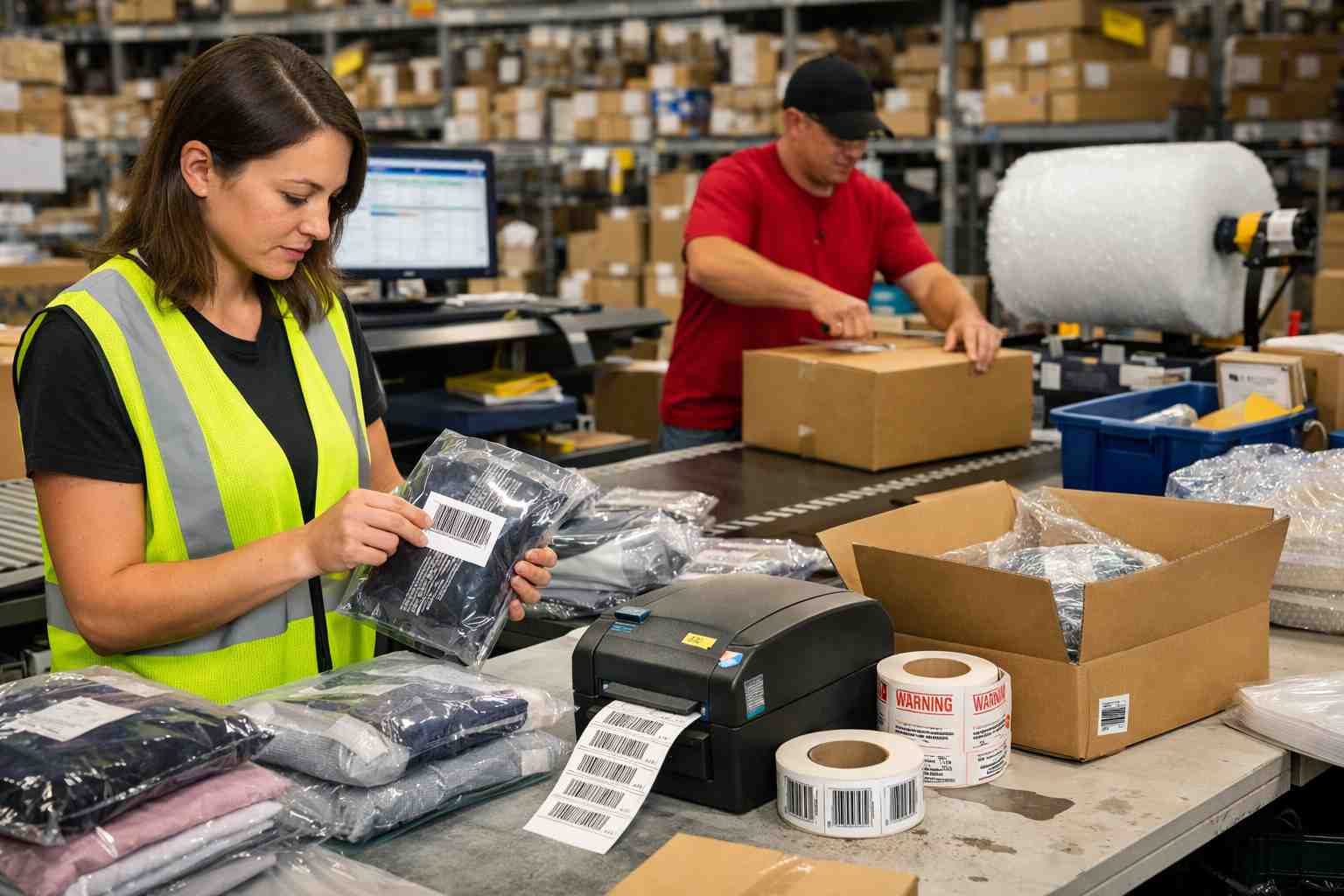
Amazon enforces strict prep standards to protect inventory integrity, maintain fulfillment center processing speed, prevent damage during storage and transit, and preserve the customer experience. These requirements are operational, not optional. When inventory arrives non-compliant, the consequences escalate quickly. Sellers may face unplanned prep chargebacks, fulfillment center shipment rejection, inventory disposal, delays in product availability, and a negative impact to their account health score. At scale, even small compliance failures compound into significant financial losses.
Poly Bagging Requirements
Poly bagging is required for products that present a suffocation hazard, contain loose components, or are vulnerable to dirt or liquid exposure. Amazon specifies that poly bags must have a minimum thickness of 1.5 mil. If the bag opening is five inches or larger, a suffocation warning label is required. The barcode must remain fully scannable through the bag, and the unit must be completely sealed. A common failure point occurs when sellers use thin retail poly bags that do not meet Amazon’s thickness or labeling requirements.

Labeling and FNSKU Requirements
FNSKU labels are used to identify inventory at the seller level within Amazon’s fulfillment network. Unlike UPC or EAN codes, which are manufacturer barcodes, the FNSKU is seller-specific. FNSKU labeling is required when a seller chooses non-commingled inventory, when the category mandates it, or when inventory control is a priority. Labels must meet minimum specifications, including a size of at least 1″ x 2⅝”, be clearly scannable, placed on a flat surface, and printed on non-glossy material. Improper placement or poor print quality frequently results in chargebacks.
Expiration Date and Lot Number Requirements
For consumables, supplements, topical products, and other date-sensitive goods, Amazon requires expiration dates to be clearly formatted and displayed. The minimum acceptable format includes at least the month and year, such as MM/YYYY. Expiration information must appear on both the individual unit and the master carton. Additionally, products must meet Amazon’s minimum shelf life requirements at the time they are received at the fulfillment center. Failure to comply typically results in automatic refusal or disposal of inventory.
Master Carton Requirements
Standard master cartons must not exceed 50 pounds unless they contain a single oversized unit, in which case the weight may go up to 100 pounds. Boxes must be structurally sound, free of damage, and properly sealed on all seams. Overweight cartons or cartons that appear damaged are frequently rejected upon arrival at the fulfillment center.
Pallet Requirements for LTL Shipments
For less-than-truckload shipments, Amazon requires GMA standard pallets. The maximum pallet height is 72 inches stacked, or 98 inches including the pallet itself. Pallets must be securely stretch wrapped, and the use of corner boards is recommended to maintain stability. Shipment labels must be placed on all four sides of the pallet. Improper stacking, unstable loads, or missing labels often lead to receiving delays or shipment refusal.
Shipment Label Placement and Compliance
FBA shipment labels must be placed on flat surfaces and remain fully visible and scannable. Labels should not overlap box edges, and they must not be covered by tape or stretch wrap. Even if packaging meets all prep standards, incorrect label placement can delay fulfillment center processing.
Amazon FBA Chargeback Fees: What They Are and How to Avoid Them
Amazon charges unplanned prep fees when it must correct non-compliant shipments. The most common triggers include missing poly bags, absent FNSKU labels, improper expiration labeling, and inadequate protective packaging. These fees typically range from approximately $0.50 to over $2.00 per unit, depending on the required corrective action. At scale, these charges multiply rapidly and can significantly reduce margins. All of these costs are preventable when sellers implement proper prep procedures before shipment.
In-House FBA Prep
Amazon FBA prep requirements cover poly bagging, FNSKU labeling, expiration date display, master carton weight limits, pallet configuration for LTL shipments, and shipment label placement. Non-compliant inventory triggers chargebacks ranging from $0.50 to over $2.00 per unit, shipment rejection, or inventory disposal. Handling FBA prep internally can offer lower marginal costs at very high shipment volumes and provides full operational control. However, it requires dedicated warehouse space, trained staff, proper equipment, and continuous monitoring of Amazon’s evolving policy requirements. Sellers must also assume full compliance risk, including exposure to chargebacks and shipment delays.
FBA Prep Service
Using a professional FBA prep service eliminates fixed overhead costs and transfers compliance expertise to a dedicated provider. Sellers benefit from faster speed to market, scalable capacity, and structured compliance procedures built into the operation. While there is a per-unit service cost, outsourcing significantly reduces compliance risk and operational complexity.
The main difference between in-house FBA prep and 3PL prep is control versus scalability. In-house prep gives you full operational control but requires warehouse space, trained staff, and constant policy monitoring. A 3PL prep service absorbs those overhead costs and compliance risks while scaling to your shipment volume.
What to Look for in a Professional FBA Prep Service Provider
A qualified FBA prep service provider should demonstrate active Amazon compliance monitoring and offer a full range of services, including poly bagging, labeling, bundling, kitting, and inspection. The provider should clearly communicate turnaround time, service level agreements, and provide visibility into receiving and inventory reporting during the prep process. Location relative to Amazon fulfillment centers, transparent pricing, and experience handling your specific product category are also important evaluation criteria. Red flags include the absence of a documented compliance process, no reporting on damage or error rates, and limited visibility into inventory status during prep.
Preguntas frecuentes
Can an FBA prep service scale with my business?
Yes, scalability is one of the primary advantages of outsourcing prep. A professional provider can absorb volume spikes, seasonal surges, and new product launches without requiring you to hire staff or expand your facility. This makes prep services particularly valuable for sellers experiencing rapid growth or unpredictable order flow.
How do I know if a prep service is actually keeping up with Amazon’s policy changes? Ask directly. A reputable provider should be able to explain how they track Amazon updates and how quickly those changes are incorporated into their process. Look for providers who proactively communicate policy changes to their clients rather than waiting for chargebacks to surface the issue. Lack of a clear answer here is a significant red flag.
What visibility will I have into my inventory while it’s at a prep center?
A quality prep service should offer clear reporting on receiving, prep status, and outbound shipments. You should know when your inventory arrived, what was inspected or flagged, and when it shipped to Amazon. Limited visibility into your inventory during the prep process is a red flag and can make it difficult to manage stock levels or troubleshoot issues.
