





 By Omri Shafran
CEO, Texas Logistic & Fulfillment Services
LinkedIn profile
Did you know? In one recurring freight-rework request received by Texas Logistic & Fulfillment Services, every shipment needed palletizing, segregation, and dimension and weight reporting, but labeling was needed on only 2 to 3 shipments out of every 10. That kind of uneven workflow is why a kitting or assembly quote should separate the repeatable base steps from exception work instead of hiding everything inside one per-kit price. This is one inquiry, not an industry benchmark.
The terms get used interchangeably, and that causes real problems when a business is trying to figure out what kind of fulfillment operation it actually needs. Kitting and assembly are related but distinct processes, and the distinction matters for how you price, plan inventory, and choose a 3PL partner with the right capabilities.
If you sell bundled products, subscription boxes, promotional sets, or any item that ships as a multi-component unit, you are already dealing with one or both of these processes, whether you have named them or not. Understanding where they differ, and where they overlap, helps you build a kitting and fulfillment operation that scales without creating SKU chaos or margin bleed.

What Kitting Is
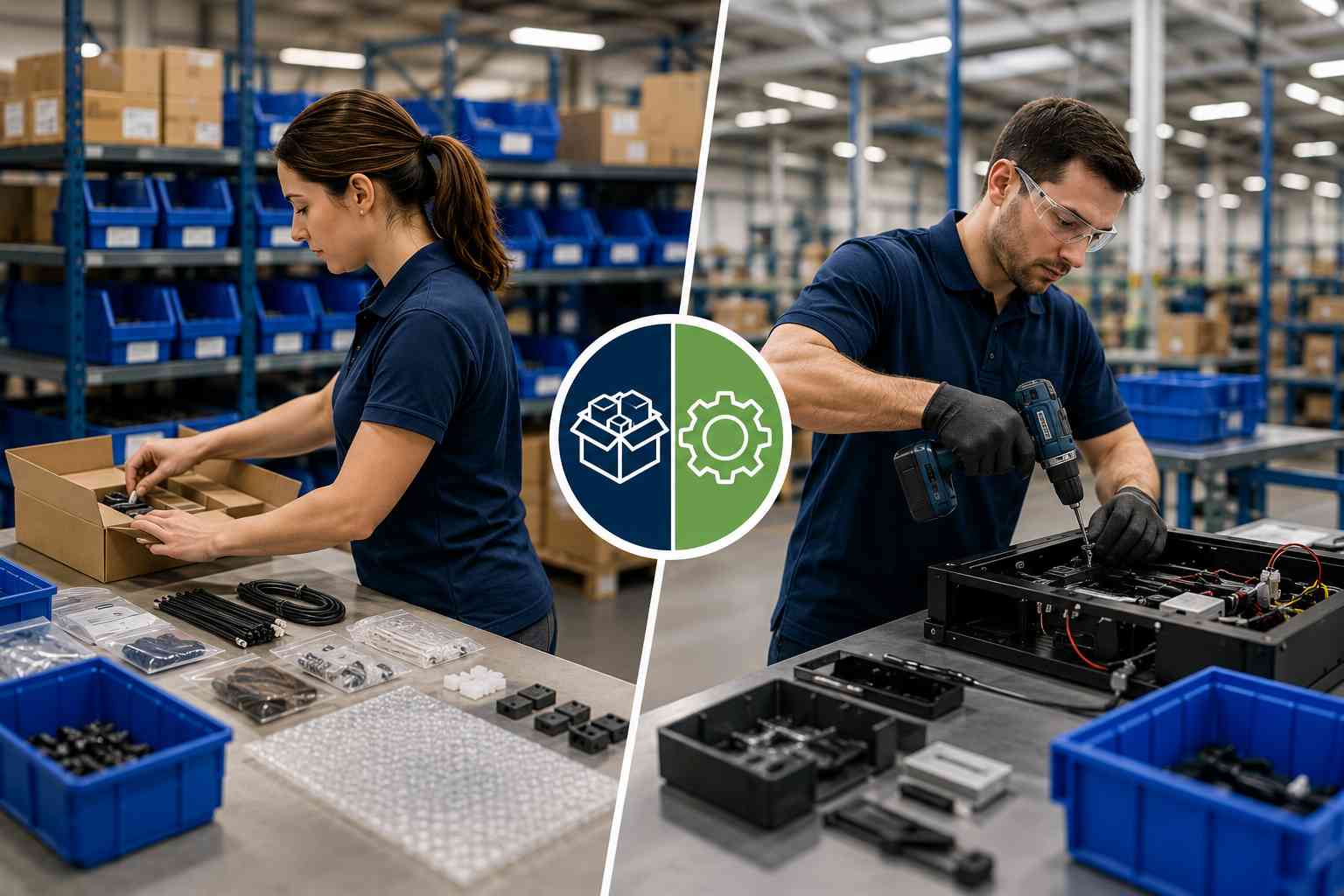
Kitting is the process of grouping separate, individually stocked items into a single sellable unit before or at the time of fulfillment. The component items exist in inventory as their own SKUs. When a kit order comes in, someone pulls each component from its respective location and combines them into a single package that ships as one unit under a single kit SKU.
A subscription box is the clearest example. You stock six individual products in your warehouse. A subscriber orders a box, and someone pulls one of each, places them in a branded box with a card, seals it, and ships it as a single unit. None of the six components changed their physical form. They were grouped, not modified.
Promotional gift sets work the same way. A skincare brand might sell a holiday set that contains a face wash, a moisturizer, and a serum, all of which are also sold individually. The kit groups them under a new SKU with its own pricing. The components themselves are unchanged.
Pre-kitting, where kits are assembled in advance and held in inventory as a kit SKU rather than assembled on demand when orders arrive, is a volume and speed decision. If you know you will sell 2,000 units of a bundle next month, pre-kitting them in a batch is faster and cheaper per unit than assembling each one as it orders. If demand is unpredictable or the bundle composition changes frequently, on-demand kitting gives you more flexibility.
What Assembly Is
Assembly involves transforming components into something that did not previously exist as a discrete product. The output is a new item that cannot be reversed into its components without destroying it, or at minimum, the components no longer have standalone value once combined.
A furniture piece shipped flat that requires physical joining of parts is assembly. A cosmetics product where pigments, oils, and preservatives are combined into a formula is assembly. A cable with connectors crimped to each end is assembly. In each case, the process created something that was not there before and cannot be simply uncombined to recover the original components.
The line between kitting and assembly can blur in light manufacturing contexts. Take a branded candle: if you are placing a pre-made candle into a branded glass vessel with a custom label, that is closer to kitting. If you are pouring the wax, adding fragrance, and setting the wick yourself, that is assembly. The distinction is whether the process transforms the components or groups them.
From a fulfillment standpoint, assembly typically requires more skilled labor, more quality control steps, and sometimes specialized equipment or facilities. It also carries different liability considerations, particularly if the assembled product is consumed, worn, or used in an application where failure has consequences. This is worth keeping in mind if your assembly process involves products that fall under regulated handling categories.
How the Operational Differences Play Out
Inventory Management
Kitting creates a multi-level inventory structure. You track component inventory at the individual SKU level and kit inventory either as a virtual bundle (the kit SKU pulls from component stock dynamically) or as a physical pre-kit with its own bin location. Either approach requires your WMS and OMS to handle the parent-child SKU relationship correctly, or you will end up with oversells when component stock runs short. A 3PL warehousing partner with proper WMS configuration handles this automatically; one without it creates a manual reconciliation problem.
Assembly has a simpler inventory structure in one sense: the finished good is its own SKU, and the raw components feed into it through a bill of materials. You track finished goods inventory and raw material inventory separately. The complexity sits in the production scheduling and quality control side rather than the fulfillment side.
Lead Time and Throughput
Kitting is generally faster per unit than assembly because no transformation is happening. A well-staffed kitting operation can process hundreds of units per hour for a simple bundle. Assembly involves process steps, cure times, inspection points, or equipment cycles that slow throughput. If you are running both kitting and assembly in the same facility, they typically operate as separate workstations because the labor profiles and tooling requirements differ.
Lead time matters more for assembly than kitting because you are manufacturing to order or to a production schedule rather than pulling finished components. If a key raw material is out of stock, your assembly line stops. If a kit component is out of stock, you can sometimes substitute or offer the kit without that component depending on your policy. The supply chain risk profile is different.
Returns Handling
A returned kit can often be broken back into its components and restocked individually if the components are undamaged. This is a meaningful inventory recovery option for higher-value bundles. A returned assembled product usually cannot be disassembled back to raw materials, so the resale options are the finished good at a discount, liquidation, or disposal. Your return processing instructions to your 3PL need to reflect this difference, and the grading rubric for a returned kit versus a returned assembled product will look quite different.
When a Business Needs Both
Many product businesses reach a point where they need kitting and assembly running in the same operation. A supplement brand might manufacture their capsule products through an assembly process, then kit them into monthly subscription boxes that also include an insert card, a shaker bottle, and a branded pouch. The capsule product is assembled; the subscription box is kitted.
Consumer electronics brands run similar workflows. A device gets assembled from components, then kitted with a charger, a manual, and packaging inserts before shipping. The device itself went through assembly; the retail package it ships in is a kit.
Promotional and seasonal product lines often push companies toward both processes at the same time. A peak season might require you to assemble a limited-edition variant of a core product while simultaneously running a kitting operation to create gift sets that bundle it with accessories. If your fulfillment partner cannot handle both workstreams concurrently without one interfering with the other, you end up with delays in one or the other during exactly the period when speed matters most.
The operational requirement in this scenario is a 3PL fulfillment partner with dedicated space and staffing for each workstream, plus the WMS infrastructure to track both finished kits and assembled goods as distinct inventory types without conflating the two. A warehouse that treats kitting and assembly as the same thing will eventually create a costing, tracking, or quality problem.
What to Look for in a 3PL for Kitting and Assembly Work
Not every 3PL is set up for value-added services. Standard pick-and-ship operations move inventory that was already ready to ship when it arrived. Kitting and assembly require dedicated labor, workspace, tooling, and quality control checkpoints that add complexity to the operation.
When evaluating a provider, ask specifically whether kitting is handled as a standalone workstation or whether pickers are expected to kit as part of the pick process. Inline kitting, where the kit is assembled during the pick cycle, works for simple bundles but breaks down with more complex configurations or high volume. A dedicated kitting station with a bill of materials checklist and a scan-to-verify step produces better accuracy at scale.
For assembly, ask about quality control procedures, reject rates, and how rework is handled. If your assembled product has a defect rate, you want to know the 3PL has a documented process for catching and reprocessing defects rather than shipping them. Ask whether they have handled similar products before and whether they can share throughput benchmarks from comparable accounts.
Also ask about how kitting instructions are documented and updated. If your bundle composition changes seasonally or you run multiple kit configurations simultaneously, the 3PL needs a reliable way to update work instructions across their team without kitting errors during the transition. This is an operational process question, not just a technology question, and it is one of the clearer signals of whether a provider has real experience with kitting services or is offering it as an add-on to standard warehousing.
How Kitting and Assembly Are Typically Priced
Kitting is usually priced per kit or per component touch, meaning you pay a base fee per kit assembled plus a per-item fee for each component included. A three-component kit costs less per unit than a seven-component kit because the labor per unit scales with complexity. Pre-kitting in batch is priced at a lower per-unit rate than on-demand kitting because the labor is more efficient in a batch run.
Assembly pricing depends on the process. Light assembly with simple steps and no equipment is priced similarly to complex kitting. More involved assembly with tooling, cure time, or inspection steps is priced higher per unit and often includes a setup fee for configuring the workstation. Some 3PLs charge a project management fee for new assembly programs during the first production run. Get this in writing during onboarding so it is not a surprise on your first invoice. Your broader 3PL shipping and storage costs apply on top of kitting and assembly fees, so build the full unit economics before committing to a pricing model.
Storage cost is a factor worth modeling separately for kitting operations. If you pre-kit in large batches, those kits occupy bin space. If you run on-demand kitting, the components occupy space plus there is labor time added to each order. The right approach depends on your demand predictability, the physical size of the components, and your storage cost per cubic foot at your 3PL.
Working with Texas Logistics Services on Kitting and Assembly
Kitting and assembly are both value-added services that require a provider with the right setup, not just the willingness to try. The difference between a 3PL that does kitting well and one that treats it as an afterthought shows up in your accuracy rates, your cost per unit, and the amount of time you spend correcting errors.
Texas Logistics Services runs dedicated kitting operations for e-commerce brands and B2B shippers, with documented work instructions, scan-to-verify processes, and the WMS infrastructure to handle multi-component inventory correctly. If you have a kitting or light assembly requirement and want to understand what outsourcing it looks like for your specific SKU profile and volume, our team can walk you through the numbers.
Call us at (346) 766-2151 or visit texaslogisticservices.com to request a quote and discuss how we can build a kitting program that fits your operation.
