




Did you know? Published B2B and direct-to-consumer handling benchmarks differ by 51.4%. The Fulfillment Advisor's 2026 survey reports $4.86 for a one-item B2B order versus $3.21 for a one-item DTC order. Our calculation compares those averages; it is not a same-provider quote or TLS pricing. For a Houston 3PL serving both channels from shared inventory, request separate handling specifications and prices for each channel. Source: The Fulfillment Advisor, 2026 survey.
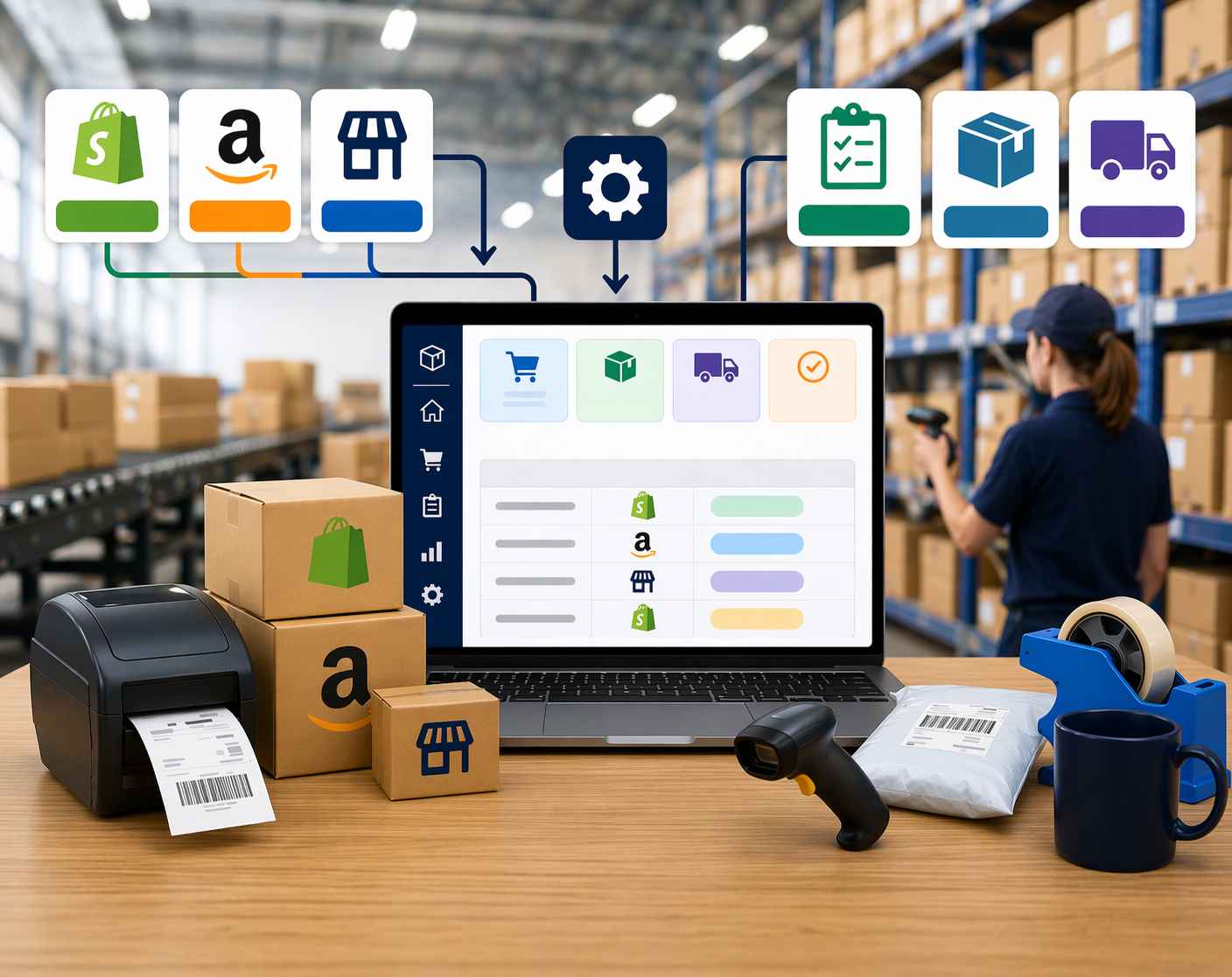
Multi-channel fulfillment is the process of receiving, picking, packing, and shipping orders across multiple sales channels – Shopify, Amazon, brick-and-mortar retail, wholesale accounts, and others – from a single inventory pool and operational workflow. When it works, every channel gets the same speed and accuracy. When it does not, you end up with overselling, inconsistent delivery times, and warehouse operations that grow more chaotic with every new channel you add.
This article covers how multi-channel fulfillment actually works, where the common breakdowns happen, and what you need from a 3PL partner to manage Shopify, Amazon, and retail orders out of one system without rebuilding your operations every time your channel mix changes.

What Multi-Channel Fulfillment Actually Involves
Multi-channel fulfillment is not just shipping from multiple channels. It means:
- A single inventory pool shared across all channels, with real-time visibility into available stock
- Channel-specific fulfillment rules – Amazon has its own label, packaging, and SLA requirements; retail purchase orders have routing guides; Shopify orders have branded insert and delivery expectations
- Unified receiving and putaway so inbound inventory is immediately allocatable to any channel
- Consolidated reporting that shows you fulfillment performance by channel, not just in aggregate
The alternative – running siloed fulfillment per channel – creates the inventory fragmentation problem. You hold safety stock for Amazon separately from Shopify, separately from retail, tie up working capital in redundant inventory, and still run out of stock on a channel because the physical units are sitting in the wrong bucket.
The Core Challenge: Channel-Specific Requirements on Shared Inventory
Each channel you sell through has its own operational requirements, and they do not overlap cleanly.
Amazon
Amazon orders fulfilled through Seller Central (FBM) or a 3PL require Amazon-compliant packaging, a specific label format, and delivery confirmation within the promised window. If you use FBA for some SKUs and a 3PL for others, you are managing two separate inventory pools and two separate inbound workflows – unless your 3PL has an integrated FBA prep function.
Amazon also applies performance metrics directly to your seller account. Late shipment rate, pre-fulfillment cancellation rate, and valid tracking rate all affect your account health. A fulfillment partner handling Amazon orders needs to understand these metrics, not just treat Amazon orders as standard parcel shipments.
Shopify (DTC)
Shopify orders typically carry higher customer experience expectations than marketplace orders. Buyers on your own site expect branded packaging, accurate tracking notifications, and faster delivery than a marketplace order might promise. You have more control over the unboxing experience, but that also means your 3PL needs to execute inserts, custom dunnage, or specific pack instructions at the SKU level.
Shopify also generates more variable order volumes – promotional events, new product launches, and influencer spikes can multiply daily order volume overnight. Your fulfillment infrastructure needs to absorb those peaks without slipping on SLAs across your other channels.
Retail and Wholesale
Retail replenishment orders come with routing guides – retailer-specific instructions governing carton labeling, pallet configuration, ASN (advance ship notice) requirements, and delivery windows. Non-compliance triggers chargebacks, which quietly erode your margin on every retail order.
Wholesale orders are typically larger and less frequent than DTC orders but require different pick and pack workflows – full case picks rather than each picks, pallet assembly, and freight carrier coordination rather than parcel.
Where Multi-Channel Fulfillment Breaks Down
Most multi-channel fulfillment problems trace back to one of four root causes.
Inventory not synced in real time
If your Shopify store, Amazon listing, and wholesale order management system are not pulling from the same live inventory count, you will oversell. A customer places an order on Shopify for the last three units, Amazon has already sold two of them, and the sync has a 30-minute lag. The result is a cancellation, a negative review, or both.
Channel-specific processes running as separate workflows
When Amazon orders go to one area of the warehouse, and Shopify orders go to another, with different staff and different processes, you lose the efficiency of a unified operation. You also create a scenario where a surge in one channel pulls resources away from another.
3PL is not integrated with your channel tech stack
If your 3PL does not have a direct integration with Shopify, Amazon Seller Central, and your wholesale order management system, you are either manually pushing orders or running batch imports. Both create lag and both create errors. A 3PL operating a modern WMS should be able to pull orders from all channels automatically and push tracking data back to each channel as shipments go out.
No unified view of fulfillment performance by channel
If your 3PL reports only aggregate fulfillment metrics, you cannot identify that your retail routing guide compliance is perfect but your Amazon on-time rate is slipping. Visibility at the channel level is what allows you to catch performance issues before they become account penalties or retailer chargebacks.
What to Look for in a 3PL for Multi-Channel Fulfillment
Not every 3PL is built for multi-channel complexity. When you are evaluating providers, the capabilities that matter most for managing Shopify, Amazon, and retail orders out of one system are:
WMS with real-time inventory visibility across channels
Your 3PL’s warehouse management system should maintain a single inventory record that all channel integrations pull from. When a unit is picked for a Shopify order, available inventory across every channel should update immediately. Batch inventory updates are not sufficient for multi-channel operations with meaningful volume.
Native integrations with Shopify and Amazon Seller Central
Direct API integrations with your sales channels eliminate the manual handoff between your order management and the warehouse. Orders flow in automatically, tracking flows back automatically, and inventory counts stay current across platforms without human intervention.
Amazon FBA prep capability
If you use FBA for any portion of your Amazon business, having your 3PL handle FBA prep alongside your FBM and DTC fulfillment keeps all inventory under one roof. Your 3PL receives your products, preps and labels what goes to Amazon, ships the FBA units to Amazon fulfillment centers, and handles everything else direct-to-consumer or direct-to-retail.
Texas Logistics Services provides Amazon FBA prep services alongside standard fulfillment, so you do not need to split your inventory between an FBA prep center and a DTC fulfillment provider.
Channel-specific pack-out execution
Your 3PL needs to be able to apply different pack instructions by channel and by SKU. Amazon orders may need poly-bagging or bubble wrap. Shopify orders may need a branded insert and specific outer carton. Retail orders need a specific carton label format and may require pallet configuration that matches a retailer’s dock requirements. A capable 3PL stores these rules in its WMS and applies them automatically at the pick station.
Kitting and bundling support
Multi-channel sellers frequently need to create channel-specific bundles – a product sold individually on Shopify may be bundled as a two-pack for Amazon or assembled as a retail kit for a big-box store. Montagem de kits capabilities at your 3PL allow you to manage a single component inventory and assemble finished bundles on demand rather than holding pre-assembled units for every channel configuration.
Retail compliance experience
Routing guide compliance requires operational detail work – specific carton label formats, correct EDI document submission, accurate ASN timing, and pallet configurations built to the retailer’s specification. A 3PL that primarily handles DTC may not have the process discipline retail requires. Ask specifically about chargeback rates and routing guide compliance before committing.
How to Consolidate Shopify, Amazon, and Retail Into One Fulfillment Operation
The practical steps for consolidating multi-channel fulfillment under a single 3PL provider look like this:
- Audit your current channel-specific inventory allocations
Before consolidating, map where your inventory currently lives and how it is allocated by channel. Identify the safety stock you are holding per channel and calculate the total working capital tied up in inventory fragmentation. This gives you a baseline for the efficiency gain from moving to a shared pool.
- Map channel-specific requirements before onboarding
Document the pack-out requirements, SLA commitments, and compliance rules for every channel before you bring a 3PL in. The onboarding conversation needs to cover Amazon packaging specs, your Shopify branded pack-out instructions, and every retailer routing guide in your current mix. A good 3PL will ask for all of this upfront and build it into your item master and WMS rules before the first order ships.
- Confirm integrations before going live
Every channel integration should be tested end-to-end – order injection, inventory deduction, tracking pushback – before you cut over. Do not go live on a new 3PL relationship on the Friday before a promotional event.
- Set channel-level SLA targets and reporting cadence
Define what good looks like for each channel. Amazon’s on-time rate, Shopify’s ship-same-day rate, retail on-time delivery, and chargeback rate should each have a target and a reporting cadence. Review at the channel level, not just in aggregate.
The Role of Warehousing and Fulfillment Infrastructure in Multi-Channel Success
Multi-channel fulfillment is not only a technology problem – it is also a space and labor problem. As your channel mix grows, your warehouse operation needs to handle more SKUs, more inbound streams, more pack-out configurations, and higher peak volumes without sacrificing the SLAs on any channel.
Scalable 3PL warehousing that can flex with your volume – both for storage and for labor – is the infrastructure layer that makes everything else work. If your warehouse runs out of space during Q4 or cannot staff up for a product launch, your channel performance suffers regardless of how well your integrations work.
Efficient Cumprimento 3PL operations – clean receiving, organized storage, accurate picking, and reliable ship-same-day execution – are the baseline that multi-channel complexity runs on. Get that layer right, and adding a new channel becomes an integration and a rule set. Get it wrong, and every new channel amplifies the underlying disorder.
Multi-Channel Fulfillment With Texas Logistics Services
Texas Logistics Services operates out of Sugar Land, TX, and provides fulfillment, warehousing, and shipping services for businesses selling across DTC, Amazon, and retail channels. The facility supports Amazon FBA prep, Shopify order fulfillment, wholesale routing guide compliance, and kitting for channel-specific bundle configurations.
Outbound 3PL shipping is managed under the same roof, giving you carrier flexibility and consolidated freight management rather than handling carrier relationships separately from your warehouse partner.
